

What Is Energy Stored In Matter Because Of Its Chemical Makeup Chemical,energy
Affiliate 5. Thermochemistry
5.ane Energy Basics
Learning Objectives
Past the finish of this section, y'all will be able to:
- Define energy, distinguish types of energy, and describe the nature of energy changes that back-trail chemic and physical changes
- Distinguish the related properties of estrus, thermal energy, and temperature
- Define and distinguish specific heat and heat capacity, and describe the concrete implications of both
- Perform calculations involving heat, specific rut, and temperature change
Chemical changes and their accompanying changes in energy are important parts of our everyday earth (Figure one). The macronutrients in nutrient (proteins, fats, and carbohydrates) undergo metabolic reactions that provide the free energy to keep our bodies functioning. We burn a diverseness of fuels (gasoline, natural gas, coal) to produce energy for transportation, heating, and the generation of electricity. Industrial chemical reactions use enormous amounts of free energy to produce raw materials (such as iron and aluminum). Free energy is and so used to industry those raw materials into useful products, such as cars, skyscrapers, and bridges.
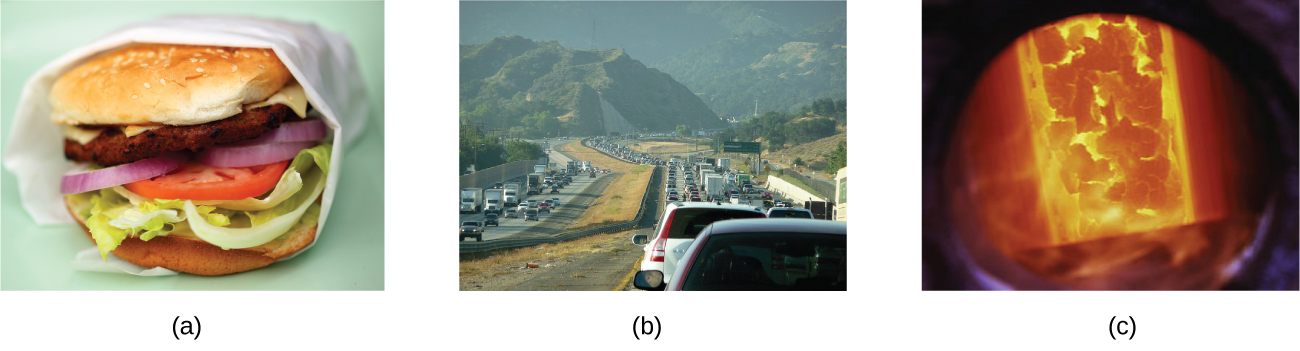
Over 90% of the free energy we use comes originally from the lord's day. Every mean solar day, the sun provides the earth with almost 10,000 times the amount of free energy necessary to meet all of the world'due south energy needs for that day. Our claiming is to observe means to convert and store incoming solar free energy then that information technology can be used in reactions or chemic processes that are both convenient and nonpolluting. Plants and many bacteria capture solar energy through photosynthesis. We release the energy stored in plants when we fire wood or found products such every bit ethanol. We as well apply this energy to fuel our bodies past eating food that comes direct from plants or from animals that got their free energy by eating plants. Burning coal and petroleum likewise releases stored solar energy: These fuels are fossilized plant and animal matter.
This chapter will introduce the basic ideas of an important area of science concerned with the amount of heat absorbed or released during chemical and physical changes—an expanse chosen thermochemistry. The concepts introduced in this chapter are widely used in nearly all scientific and technical fields. Nutrient scientists use them to decide the free energy content of foods. Biologists study the energetics of living organisms, such as the metabolic combustion of sugar into carbon dioxide and water. The oil, gas, and transportation industries, renewable energy providers, and many others effort to find meliorate methods to produce free energy for our commercial and personal needs. Engineers strive to improve free energy efficiency, find better ways to heat and cool our homes, refrigerate our food and drinks, and meet the free energy and cooling needs of computers and electronics, among other applications. Understanding thermochemical principles is essential for chemists, physicists, biologists, geologists, every type of engineer, and simply most anyone who studies or does whatever kind of science.
Energy
Energy tin can be defined equally the capacity to supply heat or do piece of work. I blazon of work (due west) is the procedure of causing matter to motion against an opposing forcefulness. For example, nosotros do work when we inflate a bike tire—we move matter (the air in the pump) against the opposing force of the air already in the tire.
Like matter, energy comes in unlike types. One scheme classifies energy into two types: potential energy, the energy an object has because of its relative position, composition, or condition, and kinetic free energy, the free energy that an object possesses because of its move. Water at the top of a waterfall or dam has potential energy because of its position; when it flows downward through generators, it has kinetic energy that can be used to do work and produce electricity in a hydroelectric plant (Figure 2). A battery has potential free energy considering the chemicals inside information technology can produce electricity that tin can practice work.
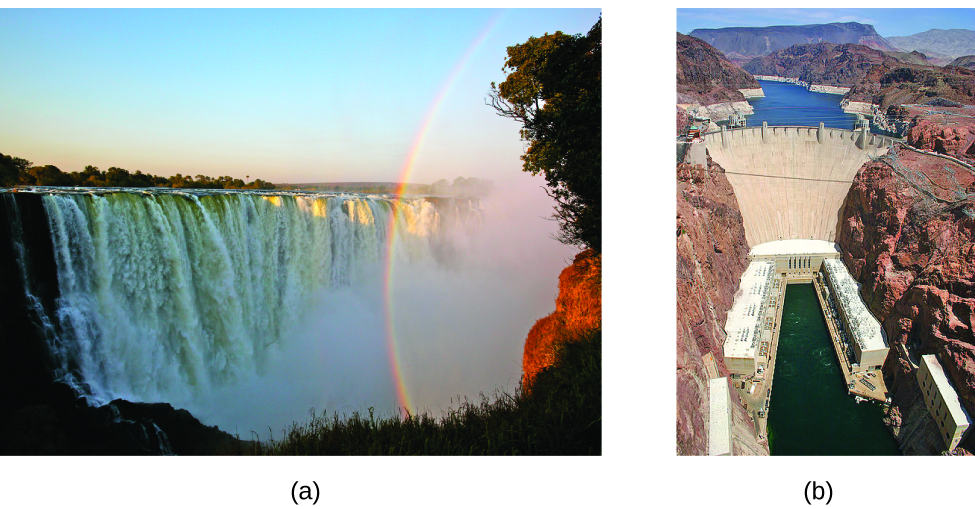
Energy tin can be converted from 1 form into some other, just all of the energy present before a modify occurs always exists in some class after the change is completed. This observation is expressed in the law of conservation of energy: during a chemic or physical change, energy can exist neither created nor destroyed, although it can be changed in form. (This is too i version of the first constabulary of thermodynamics, equally you will learn later.)
When one substance is converted into another, there is always an associated conversion of 1 form of energy into another. Estrus is usually released or captivated, simply sometimes the conversion involves lite, electric energy, or another form of energy. For case, chemic free energy (a type of potential free energy) is stored in the molecules that compose gasoline. When gasoline is combusted within the cylinders of a car'due south engine, the rapidly expanding gaseous products of this chemical reaction generate mechanical energy (a type of kinetic energy) when they move the cylinders' pistons.
According to the police of conservation of matter (seen in an earlier chapter), there is no detectable change in the total amount of thing during a chemic change. When chemical reactions occur, the energy changes are relatively modest and the mass changes are as well minor to mensurate, so the laws of conservation of matter and free energy hold well. However, in nuclear reactions, the energy changes are much larger (by factors of a million or so), the mass changes are measurable, and thing-free energy conversions are meaning. This volition be examined in more detail in a afterward chapter on nuclear chemistry. To encompass both chemical and nuclear changes, nosotros combine these laws into one statement: The full quantity of matter and energy in the universe is fixed.
Thermal Free energy, Temperature, and Heat
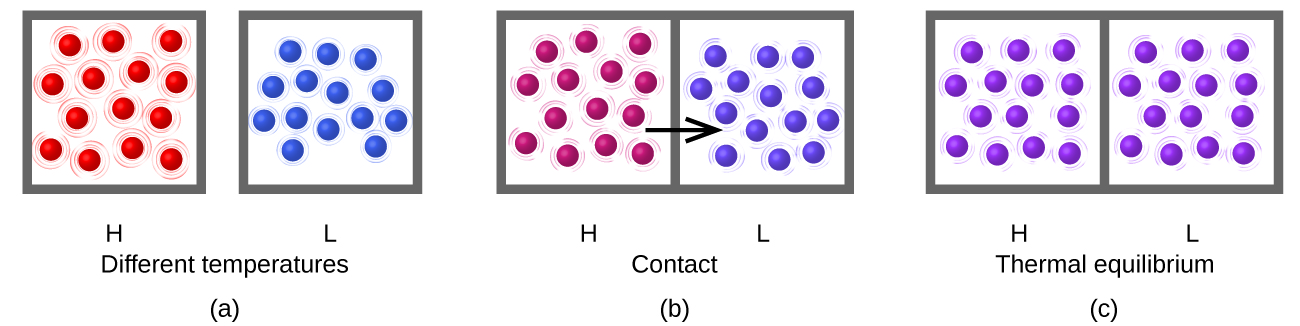
Thermal free energy is kinetic free energy associated with the random motion of atoms and molecules. Temperature is a quantitative measure of "hot" or "cold." When the atoms and molecules in an object are moving or vibrating quickly, they have a higher average kinetic free energy (KE), and nosotros say that the object is "hot." When the atoms and molecules are moving slowly, they accept lower KE, and we say that the object is "cold" (Figure 3). Assuming that no chemical reaction or phase change (such as melting or vaporizing) occurs, increasing the amount of thermal energy in a sample of thing will cause its temperature to increment. And, bold that no chemical reaction or phase alter (such as condensation or freezing) occurs, decreasing the corporeality of thermal energy in a sample of matter will cause its temperature to decrease.
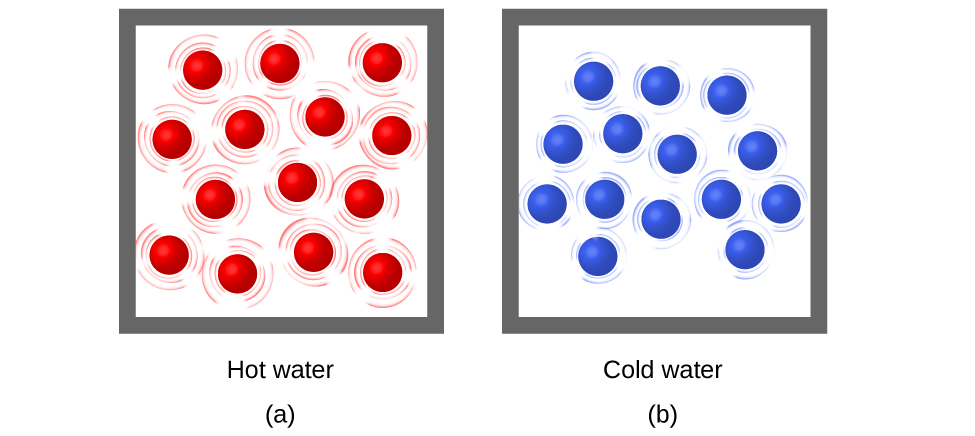

Click on this interactive simulation to view the effects of temperature on molecular motion.
Most substances expand as their temperature increases and contract every bit their temperature decreases. This property can exist used to measure temperature changes, equally shown in Figure 4. The operation of many thermometers depends on the expansion and contraction of substances in response to temperature changes.
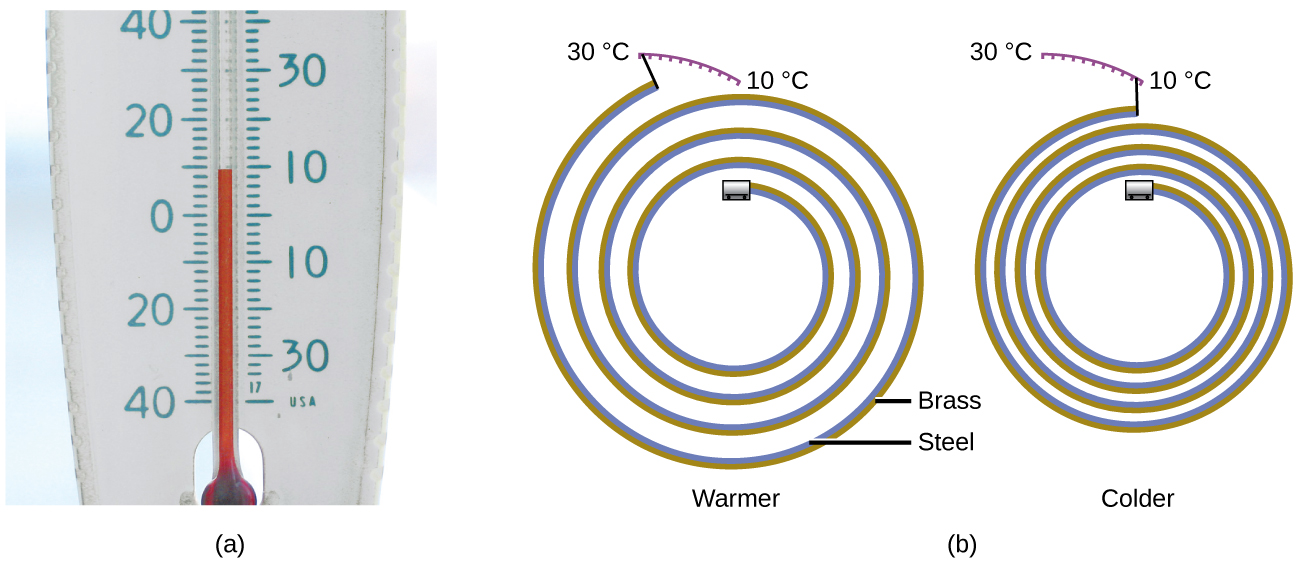
The following demonstration allows 1 to view the furnishings of heating and cooling a coiled bimetallic strip.
Heat (q) is the transfer of thermal energy between ii bodies at different temperatures. Estrus flow (a redundant term, only one commonly used) increases the thermal energy of one body and decreases the thermal energy of the other. Suppose we initially have a high temperature (and high thermal energy) substance (H) and a low temperature (and low thermal energy) substance (Fifty). The atoms and molecules in H have a higher boilerplate KE than those in Fifty. If we place substance H in contact with substance L, the thermal free energy volition period spontaneously from substance H to substance L. The temperature of substance H will decrease, equally will the boilerplate KE of its molecules; the temperature of substance L will increase, along with the average KE of its molecules. Heat flow will go along until the two substances are at the same temperature (Effigy five).
Click on the PhET simulation to explore free energy forms and changes. Visit the Energy Systems tab to create combinations of energy sources, transformation methods, and outputs. Click on Energy Symbols to visualize the transfer of energy.
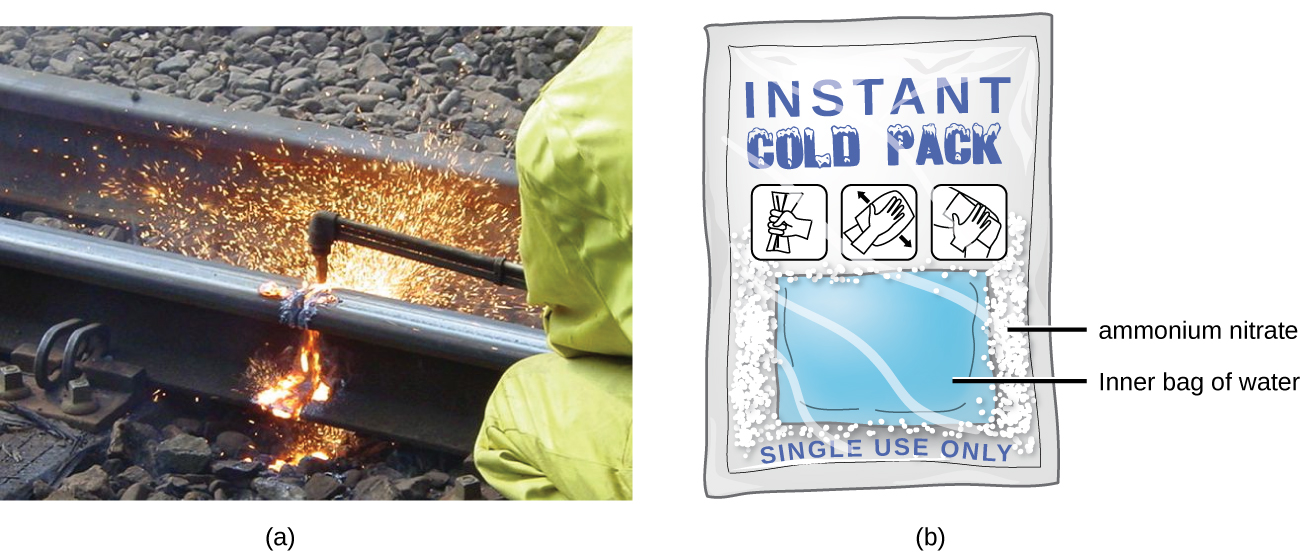
Matter undergoing chemic reactions and physical changes tin release or absorb heat. A change that releases estrus is called an exothermic process. For case, the combustion reaction that occurs when using an oxyacetylene torch is an exothermic process—this process also releases energy in the course of light equally evidenced by the torch'southward flame (Figure half-dozen). A reaction or modify that absorbs heat is an endothermic process. A cold pack used to treat musculus strains provides an example of an endothermic process. When the substances in the cold pack (h2o and a salt similar ammonium nitrate) are brought together, the resulting process absorbs heat, leading to the awareness of cold.
Historically, energy was measured in units of calories (cal). A calorie is the amount of energy required to enhance ane gram of water past 1 degree C (1 kelvin). However, this quantity depends on the atmospheric force per unit area and the starting temperature of the water. The ease of measurement of energy changes in calories has meant that the calorie is nevertheless frequently used. The Calorie (with a capital C), or large calorie, ordinarily used in quantifying food energy content, is a kilocalorie. The SI unit of measurement of heat, work, and energy is the joule. A joule (J) is defined equally the corporeality of energy used when a forcefulness of i newton moves an object i meter. It is named in award of the English physicist James Prescott Joule. Ane joule is equivalent to i kg m2/southward2, which is as well chosen 1 newton–meter. A kilojoule (kJ) is thousand joules. To standardize its definition, 1 calorie has been set to equal 4.184 joules.
We now introduce 2 concepts useful in describing estrus catamenia and temperature change. The oestrus capacity (C) of a body of matter is the quantity of heat (q) it absorbs or releases when it experiences a temperature change (ΔT) of 1 degree Celsius (or equivalently, i kelvin):
[latex]C = \frac{q}{\Delta T}[/latex]
Estrus capacity is adamant by both the type and corporeality of substance that absorbs or releases heat. It is therefore an extensive property—its value is proportional to the amount of the substance.
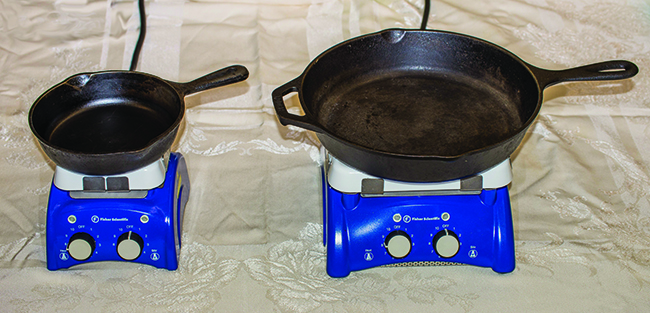
For example, consider the heat capacities of two cast iron frying pans. The heat chapters of the large pan is five times greater than that of the pocket-size pan because, although both are made of the aforementioned cloth, the mass of the large pan is five times greater than the mass of the pocket-sized pan. More mass means more atoms are present in the larger pan, so it takes more free energy to make all of those atoms vibrate faster. The heat capacity of the modest cast fe frying pan is found by observing that it takes xviii,150 J of energy to raise the temperature of the pan by fifty.0 °C:
[latex]C_{\text{pocket-sized pan}} = \frac{18,140 \;\text{J}}{fifty.0 \;^{\circ}\text{C}} = 363 \;\text{J/}^\circ\text{C}[/latex]
The larger cast atomic number 26 frying pan, while fabricated of the same substance, requires 90,700 J of free energy to heighten its temperature by 50.0 °C. The larger pan has a (proportionally) larger heat capacity because the larger corporeality of textile requires a (proportionally) larger corporeality of energy to yield the aforementioned temperature change:
[latex]C_{\text{large pan}} = \frac{90,700 \;\text{J}}{l.0 \;^{\circ}\text{C}} = 1814 \;\text{J/}^\circ\text{C}[/latex]
The specific heat chapters (c) of a substance, commonly called its "specific heat," is the quantity of heat required to raise the temperature of 1 gram of a substance by 1 degree Celsius (or 1 kelvin):
[latex]C = \frac{q}{m\Delta T}[/latex]
Specific heat capacity depends simply on the kind of substance arresting or releasing oestrus. It is an intensive belongings—the type, just not the amount, of the substance is all that matters. For example, the small-scale cast atomic number 26 frying pan has a mass of 808 thou. The specific oestrus of iron (the fabric used to make the pan) is therefore:
[latex]c_{\text{iron}} = \frac{18,140 \;\text{J}}{(808 \;\text{yard})(50.0 \;^{\circ}\text{C})} = 0.449 \;\text{J/k} \;^\circ\text{C}[/latex]
The big frying pan has a mass of 4040 g. Using the data for this pan, we can also calculate the specific heat of iron:
[latex]c_{\text{atomic number 26}} = \frac{ninety,700 \;\text{J}}{(4040 \;\text{g})(l.0 \;^{\circ}\text{C})} = 0.449 \;\text{J/g} \;^\circ\text{C}[/latex]
Although the big pan is more massive than the small pan, since both are made of the aforementioned material, they both yield the same value for specific rut (for the material of construction, atomic number 26). Note that specific heat is measured in units of energy per temperature per mass and is an intensive property, beingness derived from a ratio of 2 all-encompassing properties (heat and mass). The molar heat capacity, as well an intensive property, is the rut capacity per mole of a particular substance and has units of J/mol °C (Figure 7).
Liquid h2o has a relatively high specific heat (about 4.2 J/thousand °C); most metals have much lower specific heats (usually less than i J/chiliad °C). The specific heat of a substance varies somewhat with temperature. Notwithstanding, this variation is usually small enough that nosotros will care for specific rut as constant over the range of temperatures that will exist considered in this chapter. Specific heats of some mutual substances are listed in Table 1.
| Substance | Symbol (country) | Specific Estrus (J/g °C) |
|---|---|---|
| helium | He(g) | 5.193 |
| water | H2O(fifty) | 4.184 |
| ethanol | C2H6O(l) | ii.376 |
| ice | H2O(s) | 2.093 (at −10 °C) |
| water vapor | HiiO(k) | one.864 |
| nitrogen | N2(thou) | ane.040 |
| air | ||
| oxygen | O2(g) | 0.918 |
| aluminum | Al(s) | 0.897 |
| carbon dioxide | CO2(yard) | 0.853 |
| argon | Ar(yard) | 0.522 |
| iron | Fe(s) | 0.449 |
| copper | Cu(s) | 0.385 |
| atomic number 82 | Pb(s) | 0.130 |
| gold | Au(s) | 0.129 |
| silicon | Si(south) | 0.712 |
| Table 1. Specific Heats of Common Substances at 25 °C and i bar | ||
If we know the mass of a substance and its specific heat, we can determine the amount of estrus, q, entering or leaving the substance by measuring the temperature modify before and later on the heat is gained or lost:
[latex]\begin{assortment} {r @{{}={}} fifty} q & \text{(specific estrus)} \times \text{(mass of substance)} \times \text{(temperature change)} \\[1em] q & c \times m \times \Delta T =c \times one thousand \times (T_{\text{last}} - T_{\text{initial}}) \end{assortment}[/latex]
In this equation, c is the specific heat of the substance, one thousand is its mass, and ΔT (which is read "delta T") is the temperature alter, T last − T initial. If a substance gains thermal free energy, its temperature increases, its final temperature is higher than its initial temperature, T final − T initial has a positive value, and the value of q is positive. If a substance loses thermal energy, its temperature decreases, the final temperature is lower than the initial temperature, T final − T initial has a negative value, and the value of q is negative.
Instance ane
Measuring Heat
A flask containing 8.0 × 10² g of water is heated, and the temperature of the h2o increases from 21 °C to 85 °C. How much heat did the water blot?
Solution
To answer this question, consider these factors:
- the specific rut of the substance being heated (in this case, water)
- the corporeality of substance being heated (in this case, 800 chiliad)
- the magnitude of the temperature change (in this case, from 21 °C to 85 °C).
The specific heat of water is four.184 J/1000 °C, so to heat one g of water by ane °C requires four.184 J. We notation that since 4.184 J is required to oestrus 1 g of water by ane °C, we volition need 800 times equally much to heat 800 g of h2o by i °C. Finally, we notice that since 4.184 J are required to heat i g of water by 1 °C, we will need 64 times as much to heat it by 64 °C (that is, from 21 °C to 85 °C).
This can be summarized using the equation:
[latex]\begin{array} {r@ {{}={}} l} q & c \times k \times \Delta T = c \times m \times (T_{\text{last}} - T_{\text{initial}}) \\[1em] & (4.184 \;\text{J/}\dominion[0.25ex]{0.5em}{0.1ex}\hspace{-0.5em}\text{one thousand} \;^\circ\text{C} \times (800 \;\rule[0.25ex]{0.5em}{0.1ex}\hspace{-0.5em}\text{chiliad}) \times (85 - twenty) \;^\circ\text{C} \\[1em] & (4.184 \;\text{J/}\dominion[0.25ex]{0.5em}{0.1ex}\hspace{-0.5em}\text{yard} \;^\circ\rule[0.5ex]{0.75em}{0.1ex}\hspace{-0.75em}\text{C} \times (800 \;\dominion[0.25ex]{0.5em}{0.1ex}\hspace{-0.5em}\text{g}) \times (65) \;^\circ\dominion[0.5ex]{0.75em}{0.1ex}\hspace{-0.75em}\text{C} \\[1em] & 210,000 \;\text{J} (= 210 \;\text{kJ}) \stop{array}[/latex]
Because the temperature increased, the water absorbed heat and q is positive.
Cheque Your Learning
How much heat, in joules, must be added to a v.00 × xtwo-g iron skillet to increase its temperature from 25 °C to 250 °C? The specific heat of iron is 0.451 J/g °C.
Annotation that the human relationship between oestrus, specific oestrus, mass, and temperature change tin can be used to determine any of these quantities (not just heat) if the other three are known or can be deduced.
Example 2
Determining Other Quantities
A piece of unknown metal weighs 348 g. When the metal piece absorbs six.64 kJ of heat, its temperature increases from 22.iv °C to 43.six °C. Determine the specific rut of this metal (which might provide a clue to its identity).
Solution
Since mass, estrus, and temperature alter are known for this metallic, nosotros tin determine its specific heat using the relationship:
[latex]q = c \times m \times \Delta T = c \times grand \times (T_{\text{final}} - T_{\text{initial}})[/latex]
Substituting the known values:
[latex]6640 \;\text{J} = c \times (348 \;\text{g}) \times (43.6 - 22.4) \;^\circ\text{C}[/latex]
Solving:
[latex]c = \frac{6640 \;\text{J}}{(348 \;\text{chiliad}) \times (21.2 \;^\circ\text{C})} = 0.900 \;\text{J/g} \;^\circ\text{C}[/latex]
Comparing this value with the values in Table one, this value matches the specific rut of aluminum, which suggests that the unknown metallic may be aluminum.
Cheque Your Learning
A piece of unknown metallic weighs 217 g. When the metallic piece absorbs 1.43 kJ of heat, its temperature increases from 24.5 °C to 39.i °C. Determine the specific heat of this metal, and predict its identity.
Answer:
c = 0.45 J/grand °C; the metal is likely to be fe
Note: Solar Thermal Energy Power Plants
The sunlight that reaches the world contains thousands of times more energy than we before long capture. Solar thermal systems provide ane possible solution to the trouble of converting energy from the sunday into energy nosotros can use. Large-scale solar thermal plants accept different design specifics, but all concentrate sunlight to estrus some substance; the rut "stored" in that substance is so converted into electricity.
The Solana Generating Station in Arizona's Sonora Desert produces 280 megawatts of electric ability. It uses parabolic mirrors that focus sunlight on pipes filled with a heat transfer fluid (HTF) (Figure 8). The HTF so does two things: It turns water into steam, which spins turbines, which in turn produces electricity, and it melts and heats a mixture of salts, which functions as a thermal free energy storage system. After the sunday goes down, the molten salt mixture can then release enough of its stored heat to produce steam to run the turbines for vi hours. Molten salts are used considering they possess a number of beneficial properties, including loftier heat capacities and thermal conductivities.
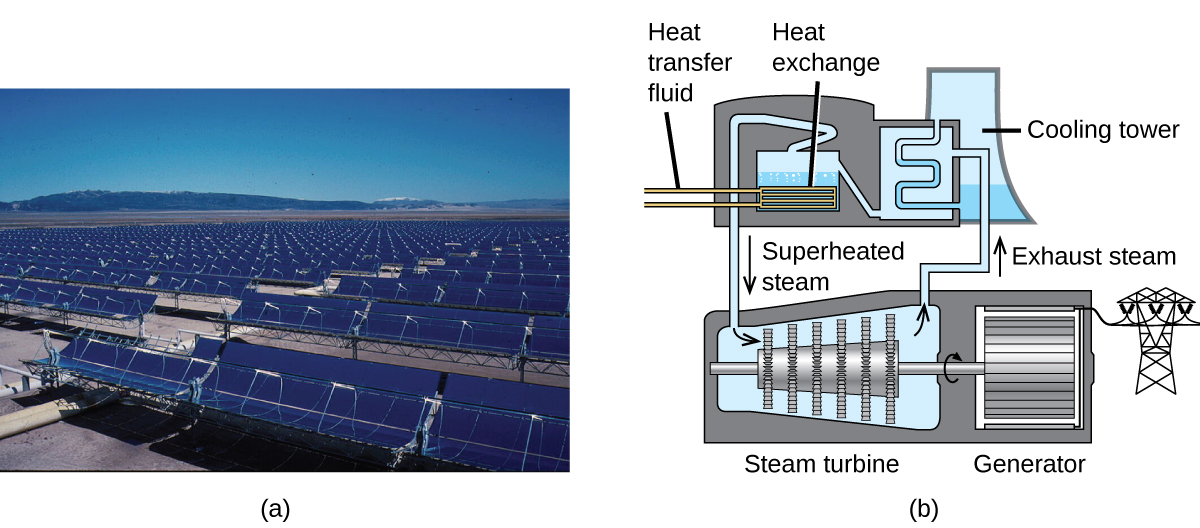
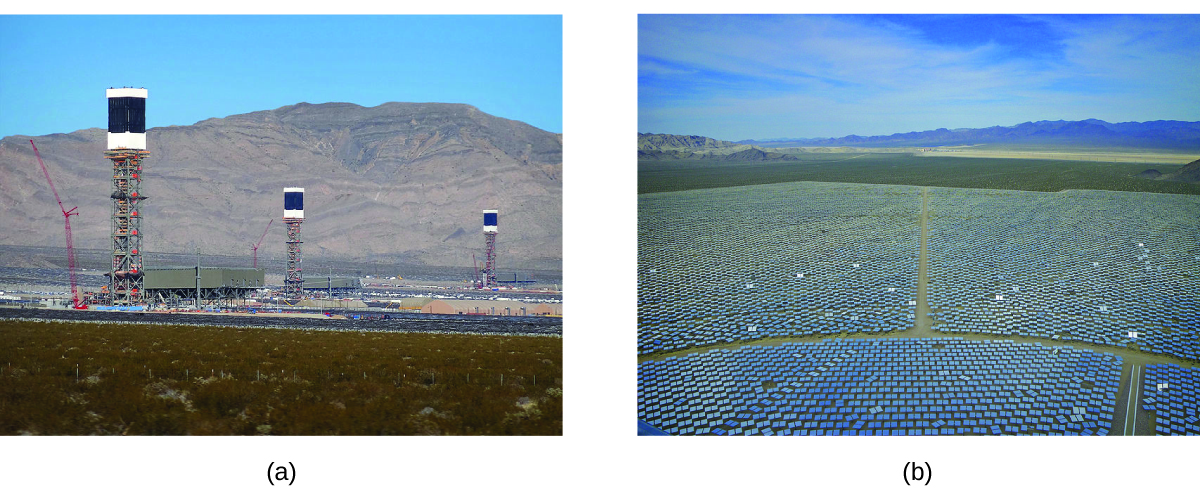
The 377-megawatt Ivanpah Solar Generating System, located in the Mojave Desert in California, is the largest solar thermal ability constitute in the world (Figure ix). Its 170,000 mirrors focus huge amounts of sunlight on three water-filled towers, producing steam at over 538 °C that drives electricity-producing turbines. Information technology produces enough energy to power 140,000 homes. Water is used every bit the working fluid because of its large heat chapters and heat of vaporization.
Cardinal Concepts and Summary
Energy is the capacity to do piece of work (applying a force to move matter). Kinetic energy (KE) is the free energy of motion; potential energy is energy due to relative position, composition, or condition. When energy is converted from one form into another, energy is neither created nor destroyed (law of conservation of energy or get-go law of thermodynamics).
Matter has thermal energy due to the KE of its molecules and temperature that corresponds to the average KE of its molecules. Heat is energy that is transferred between objects at different temperatures; it flows from a high to a low temperature. Chemical and concrete processes tin can absorb heat (endothermic) or release heat (exothermic). The SI unit of energy, heat, and work is the joule (J).
Specific heat and rut capacity are measures of the free energy needed to change the temperature of a substance or object. The corporeality of rut absorbed or released by a substance depends directly on the type of substance, its mass, and the temperature modify it undergoes.
Primal Equations
- [latex]q = c \times k \times \Delta T = c \times chiliad \times (T_{\text{final}} - T_{\text{initial}})[/latex]
Chemistry End of Affiliate Exercises
- A burning friction match and a blaze may take the aforementioned temperature, yet you would not sit around a burning friction match on a fall evening to stay warm. Why not?
- Prepare a table identifying several energy transitions that take identify during the typical operation of an automobile.
- Explicate the difference betwixt rut capacity and specific heat of a substance.
- Calculate the heat capacity, in joules and in calories per degree, of the following:
(a) 28.4 g of water
(b) 1.00 oz of lead
- Calculate the heat chapters, in joules and in calories per degree, of the following:
(a) 45.8 g of nitrogen gas
(b) 1.00 pound of aluminum metal
- How much estrus, in joules and in calories, must be added to a 75.0–thousand iron cake with a specific estrus of 0.449 J/g °C to increase its temperature from 25 °C to its melting temperature of 1535 °C?
- How much oestrus, in joules and in calories, is required to heat a 28.iv-g (1-oz) ice cube from −23.0 °C to −i.0 °C?
- How much would the temperature of 275 chiliad of water increase if 36.5 kJ of heat were added?
- If 14.5 kJ of heat were added to 485 m of liquid h2o, how much would its temperature increase?
- A piece of unknown substance weighs 44.7 g and requires 2110 J to increase its temperature from 23.2 °C to 89.6 °C.
(a) What is the specific estrus of the substance?
(b) If information technology is ane of the substances found in Tabular array 1, what is its probable identity?
- A piece of unknown solid substance weighs 437.2 g, and requires 8460 J to increase its temperature from xix.3 °C to 68.nine °C.
(a) What is the specific oestrus of the substance?
(b) If it is one of the substances establish in Tabular array i, what is its likely identity?
- An aluminum kettle weighs one.05 kg.
(a) What is the oestrus chapters of the kettle?
(b) How much heat is required to increase the temperature of this kettle from 23.0 °C to 99.0 °C?
(c) How much heat is required to oestrus this kettle from 23.0 °C to 99.0 °C if information technology contains 1.25 L of water (density of 0.997 thousand/mL and a specific estrus of 4.184 J/g °C)?
- About people find waterbeds uncomfortable unless the water temperature is maintained at near 85 °F. Unless it is heated, a waterbed that contains 892 Fifty of h2o cools from 85 °F to 72 °F in 24 hours. Guess the amount of electrical energy required over 24 hours, in kWh, to go along the bed from cooling. Note that 1 kilowatt-hour (kWh) = three.6 × 106 J, and assume that the density of water is one.0 g/mL (independent of temperature). What other assumptions did you lot make? How did they affect your calculated result (i.eastward., were they likely to yield "positive" or "negative" errors)?
Glossary
- calorie (cal)
- unit of heat or other energy; the amount of free energy required to raise i gram of h2o by 1 degree Celsius; 1 cal is defined as 4.184 J
- endothermic process
- chemical reaction or physical alter that absorbs heat
- free energy
- chapters to supply heat or do work
- exothermic process
- chemical reaction or physical change that releases oestrus
- heat (q)
- transfer of thermal free energy between two bodies
- oestrus capacity (C)
- extensive property of a body of matter that represents the quantity of oestrus required to increase its temperature by 1 degree Celsius (or 1 kelvin)
- joule (J)
- SI unit of measurement of energy; 1 joule is the kinetic free energy of an object with a mass of 2 kilograms moving with a velocity of i meter per second, 1 J = 1 kg mtwo/south and 4.184 J = ane cal
- kinetic energy
- energy of a moving body, in joules, equal to [latex]\frac{1}{ii}mv^2[/latex] (where thousand = mass and v = velocity)
- potential energy
- energy of a particle or system of particles derived from relative position, composition, or condition
- specific heat capacity (c)
- intensive property of a substance that represents the quantity of heat required to raise the temperature of 1 gram of the substance by 1 degree Celsius (or one kelvin)
- temperature
- intensive holding of thing that is a quantitative measure of "hotness" and "coldness"
- thermal energy
- kinetic energy associated with the random motion of atoms and molecules
- thermochemistry
- study of measuring the corporeality of heat captivated or released during a chemical reaction or a physical alter
- piece of work (w)
- energy transfer due to changes in external, macroscopic variables such as pressure and volume; or causing matter to move against an opposing force
Solutions
Answers to Chemistry End of Chapter Exercises
1. The temperature of one gram of burning wood is approximately the aforementioned for both a match and a bonfire. This is an intensive belongings and depends on the cloth (wood). All the same, the overall amount of produced oestrus depends on the corporeality of material; this is an extensive property. The amount of forest in a bonfire is much greater than that in a match; the total amount of produced heat is as well much greater, which is why nosotros tin sit down around a blaze to stay warm, but a match would not provide enough heat to keep us from getting cold.
3. Heat capacity refers to the heat required to raise the temperature of the mass of the substance 1 degree; specific heat refers to the heat required to raise the temperature of 1 gram of the substance ane caste. Thus, oestrus capacity is an extensive belongings, and specific heat is an intensive one.
5. (a) 47.6 J/°C; 11.38 cal °C−one; (b) 407 J/°C; 97.3 cal °C−1
7. 1310; 313 cal
ix. seven.fifteen °C
11. (a) 0.390 J/one thousand °C; (b) Copper is a likely candidate.
xiii. Nosotros presume that the density of water is ane.0 g/cmthree(1 m/mL) and that it takes equally much energy to go along the h2o at 85 °F as to heat it from 72 °F to 85 °F. We also assume that only the h2o is going to exist heated. Free energy required = 7.47 kWh
Source: https://opentextbc.ca/chemistry/chapter/5-1-energy-basics/
Posted by: davispapon1976.blogspot.com
0 Response to "What Is Energy Stored In Matter Because Of Its Chemical Makeup Chemical,energy"
Post a Comment